Showing posts with label lessons from the limb. Show all posts

Thursday, September 10, 2015

Lessons from the Limb #11 - It's a New School Year ... Time to Synchronize

Hello! We hope everyone is having a great school year so far. We just started school this week - which is super weird because we're in California NOT on the East Coast, but we're on a crazy schedule with construction that has been happening in our district. Anyway, happy first week of school to us and however many weeks to you.

If you can even believe it, this is our fourth year teaching collaboratively! We can hardly believe it ourselves!! Over the past three years of teaching together we've become more and more in sync in so many ways. There are innumerable things that just flow for us now as we've found common agreements and ways to make our program work.


We've also learned, though, that it's important not to take for granted that just because we've become more and more aligned, it doesn't necessarily mean that we're always on the same page. We also have learned how important it is to carve out some time to reflect and to refine our practice so that each year, while it might not herald ground breaking programmatic shifts, continues to improve upon what we've been doing. One way that we accomplish this is by getting together for a few hours in the summer and just going over our plans for the school year. This includes talking through all of our instructional programs, our organizational systems, and our new ideas that we want to implement for the upcoming year. We wanted to share with you the notes that we made from our summer meeting. While the content itself is probably a little bit cryptic in some parts and a lot bit specific to us personally, we hope it gives you an idea of the way that we talk through and improve upon what we're doing.

View the entire document here

So the FLY AWAY here is this: no matter how long you've been teaching together, it's always worth it to take some time to synchronize, particularly at the beginning of the year. Take some time to reflect on the last year - What worked great and what bugged you? What new things would you like to add? What can you let go of? What can you streamline? What are your hopes for the upcoming year? What are your concerns? Every relationship needs little tune-ups and a collaborative teaching partnership is no different so channel your inner synchronized swimmer and sync up!

From the limb,

Wednesday, November 6, 2013

Lessons from the Limb #9: Our Collaboration

People often ask us how our partnership works and why it works so well.  They see us collaborating and automatically assume it works because we are friends or because “we live at work.”  While it doesn’t hurt to wake up and work with a good friend, someone you admire, someone who inspires you to do more, someone who pushes you...contrary to popular belief, friendship has nothing to do with it.  We work because who chose to enter into this partnership together.  More importantly, our partnership works because we work hard to make it work.  Recently KM attended a meeting and was presented with an interesting visual about collaborative teaching which we feel sums up the inner layers of our collaborative relationship:
Image taken from Daniel Wilson's presentation in the Learning Environments for Tomorrow presentation at Harvard (April 2012).
So let's breakdown each of these four layers and by the end of this collaboration expose, the secrets of our inner workings will be unveiled for the masses.  So with out further ado:

Layer 1.  Communication.  At the base of any healthy relationship is open and honest communication.  One of the reasons why we work is that we are open with each other.  We give each other feedback, we share ideas and pedagogical knowledge, we challenge each other and we give each other compliments.  While compliments are always nice, we also don’t hesitate to challenge each other to make sure the decisions we are making are aligning with our collective goals.  It’s never personal because at the end of the day we believe in each other and trust and respect each other.  To make sure we are always checking in with each other, we have a before school check in where we go over any big things for the day and an after school check in where we reflect on the day and make preparations for the next day.  When there is a breakdown in communication, there will likely be a breakdown in collaboration.    Sometimes that happens.  We are not perfect.  Sometimes we fight.  Nothing makes the collaboration crunchier as when there is a chink in a partnership’s communication.   

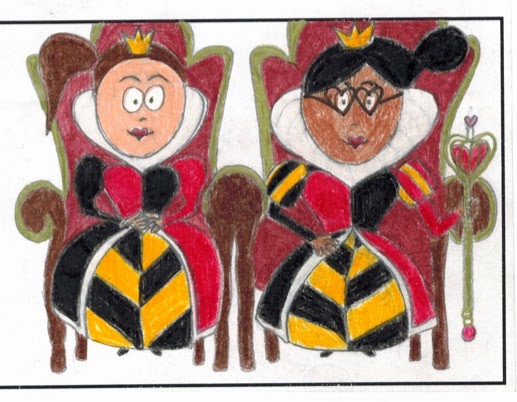
Layer 2.  Coordination.  While we were used to being the queens of our own classrooms, it was an adjustment to figure out how to rule our joint court.  There were some tough times where we tried to assert our dominance over each other.  For a collaboration to be successful, you can’t have two queens fighting for one throne.  We have found the most success in recognizing and utilizing each of our strengths and then using them to build each other up.  

"All ways here are our ways," said the Queens of Hearts.
Layer 3.  Cooperation.  Once our communication was solid, we had to make sure we were speaking the same language.  Before we started down this road of collaboration, we sat down and aligned our vision and philosophies.  You could have exceptional communication and be the best of friends, but if you don’t stand for the same things then…well….you’re heading for a hot mess.   Seriously.  It’s just like living with a friend.  Good friends don’t necessarily make good roommates.  Good friends don’t necessarily make good teaching partners.   Collaborative relationships require more than friendship and a shared love of rubrics.  You both have to be committed to pursuing the same goals and vision.  We work because each day we bring our A-game and it’s not about who thought of what or who gets credit for what, its about supporting each other to realize our vision for our students and their families.

Layer 4.  Collaboration.  When all the C’s combine, you have Captain Collaboration (cue Captain Planet theme song).  At the heart of all the four C’s lies collaboration.  When there is open and honest communication, you are both committed to the same goals, and you both work together to rule your domain, you have true collaboration.  Collaboration isn’t just about being in the same room together; it’s more about how you work together.  It is about you and your partner bringing ideas to the table to discuss and together turning them into something better than what you each could have created alone.  Our collaboration works because we are constantly reflecting, planning, brainstorming, nit-picking, revising, and reshaping our new normal together one day at a time.


So the FLY AWAY here is that just like any relationship, you get out of it what you put in.  You don’t have to be friends to have a successful collaborative partnership.  For goodness sakes you don’t have to “live at school.”  You just both have to want to be there and commit to each other and your shared goals.  If you end up becoming friends as a result of the experience, well we ain’t mad at ya. 


From the limb,

Sunday, October 13, 2013

Lessons from the Limb #8: "Fight Right", Y'all!!!

So ... we got in a fight ...


Alright, alright, we didn't get into a real fight, but we did have a disagreement - quarrel? dispute? clash? squabble? - about partnering up students, of all things, and we had to work it out. And while we did eventually come to an agreement in regards to student partnerships, the bigger take away we had was about communication and essentially how to "fight right". KH recently read a book called The Happiness Project by Gretchen Rubin ...

You can find it on Amazon here
... and one of the things that stuck with her the most was the idea that couples with healthy relationships "fight right" - they don't bring up past wrongs, they are able to laugh and joke amidst a spat, they try to really hear what the other person is saying, and they let things go once resolution is struck. While we are obviously not a couple, we think the principles of "fighting right" still apply because in many ways our relationship mirrors the components of a true marriage.

So with the idea of "fighting right" and the desire to improve our communication process, KH launched a conversation basically about how we felt our disagreement went and what we could do better in the future. This conversation, in true KH and KM reflective fashion, became a meta-analysis of our disgreement, almost like a post-game breakdown recapping each moment of the fight and where, if anywhere, commincation failures could be pinpointed with the hopes of avoiding them in the future. Now before you think we're crazy - though we admit you may have a point at times - we did this because we wanted to improve our communication, we wanted to make sure that when we were quarreling that we were still "fighting right".

We're sure that you are DYING to know the details of our squabble but, alas, we are going to disappoint you because this entry is not really about the fight itself, but what we learned from having the fight in the first place and then analyzing it together.

Realization #1: It is important to restate things to make sure that both of us are hearing the same thing.

     Revelation: Sometimes we are talking about two completely different things and we don't even realize it! Fail! Other times, we are saying the exact same thing - we actually agree! - and we don't even realize it. Double fail! Not a productive way to communicate.


     Resolution: We are going to work on following up key agreements in discussions by rephrasing. For example,


Realization #2: It is important to be crystal clear about what we've agreed upon.

     Revelation: Most often when we debate or disagree on things, they are complicated issues - regardless of what you may think after reading about our Alpha Wolf struggles for dominance. We have to sort them out and make a plan one layer at a time. What we have a tendancy to do is keep moving the conversation forward without being explicit about what we have agreed upon and what's still undecided. This either leaves us in the position of ending our conversation in a cloud of amibiguity ...


... or we keep rediscussing things we've already agreed upon. Either way, it's a waste of precious time and, as KM would say, "We don't have time for this nonsense!"

     Resolution: Well, our first plan was to hire a man named Icarus to act as our scribe and follow us around recording our agreements.


And while we're still holding out hope that someday we'll find him, in the mean time we're going to work on synthesizing exactly what we have agreed to BEFORE we move on, with each of us weighing in with a yes or no to confirm.

This all may seem ridiculous to the outsider, but one of the things we value most about our professional relationship and something we believe is essential to our success as a team is our ability to talk about and learn from our ups and downs. It would be so easy to let things fester or just leave things as they are, to accept the status quo, to not rock the boat and not push ourselves to dig deeper, but we are true believers in continuous improvement and that includes our professional relationship with each other, not just the pedagogy. After all this reflecting and discussing, analyzing and soul baring, our FLY AWAY is this: without communication and trust, collaborative teaching cannot reach its true potential for both the students and the teachers.

We'll leave you with this final reminder:

Stay classy, my friends!

From the limb,

Saturday, June 29, 2013

Lessons from the Limb #3 - Presenting Our Third Teaching Partner ... the Timer

Well, this is awkward. In trying to determine which number "Lessons from the Limb" we were on, since it's been ... ahem ... a little while since we posted, we realized that while we left off after number 7 we never did a lesson number 3 ... whoops. Well, since the chronology of this blog is already shot, we're calling this lesson #3 (shhhhhh ... don't tell anyone our mistake).

We want to show you the single best purchase that we made this year (until Kristie bought a pencil sharpener ... LAWD, don't get her started on that!).

Kristie's unhealthy love for our her new pencil sharpener

This purchase was what helped us achieve our fantasy plan of teaching 40 first graders in small groups for our Reading block. Are you ready to see our miracle purchase, our third teaching partner, the backbone of our Reader's Workshop schedule? Well ...

Drum roll, please

PRESENTING ... our timer


Do you see the size of that bad boy? Your eyes are not deceiving you; it is HUGE and we love it!

So here's the background. We had just gotten to the point where we were working with the children in small groups, and it was going great except that we were having the hardest time keeping to our schedule. First we were having a hard time getting through everything that we wanted to get through with the students each day. Things were taking FOR-EV-ER and we were getting stressed that maybe we couldn't get the students to transition efficiently enough to maximize our Reader's Workshop time like we wanted. Soooooo to solve that problem we turned to a trusty teacher tool - the timer. Both of us had used timers in the past to keep both ourselves and our students on schedule so it was a natural go-to tool for us. And it worked ... kind of.

The thing was the only timer we had was small, a kitchen-sized timer, and our classroom is ... uh ... decidedly not small. It was virtually impossible for either of us to see the timer while we were teaching. The timer was doing its job keeping us on time because we were both standardizing and limiting the amount of time we were spending with each small group, BUT we never really had any idea how much time we had left for our groups because we could not see that dang itty bitty timer. It was eye-opening to realize just how critical being aware of the time is for pacing. This may sound obvious, but to us it was a revelation at just how challenging it was to teach without any idea of how much time had passed or how much time we had left. Just another one of those things that teachers manage without even thinking about it while they are teaching, we suppose. Anyway, back to the timer - what we really need was a gimongous timer and there on Kagan's website (link for anyone who's interested: http://www.kaganonline.com/catalog/JMT/), our dreams came true.

Finding the perfect timer online

Unfortunately, it also cost us $49 before tax and shipping ... YIKES!!!

Discovering the outrageous price for the perfect timer

But in the end, it was truly worth it. We can see our timer from anywhere in the classroom and we used it constantly, c-o-n-s-t-a-n-t-l-y last year. It truly became our third teaching partner and we feel like we could not have achieved the maximizing of our school day that we did without it. It kept us on time, it kept us moving along, it helped us pace, and it helped the children monitor their independent worktime as we would use the countdown feature to help them visualize how much time they had left. We trained the children to freeze and raise their hands in the air when the timer went off. This told them that their time was up and a transition, with teacher directions of course, was about to occur. See, it really was a teaching partner; it even had its own classroom management systems!

So, what's the lesson here you may be wondering, our wise FLY AWAY? It is as simple as this: you can't do it all alone. Every teacher, no matter how dedicated, no matter how talented, no matter how simple awesome, can do everything alone all the time. Everyone needs help - be it a teaching partner, ideas from a blog, or a bangin' timer. So reach out and take the help you need! There's no time (Get it? Time ... hee hee) like the present.

We love our Mega Timer!

From the limb,

Saturday, October 20, 2012

Lessons from the Limb #7: One of Us Had a Cold but We Survived!!!

Okay, it happened ... the dreaded moment ... one of us needed a sub. OH MY! Poor Ms. B held on for two days fighting a nasty cold before she succumbed to it and needed to stay home. Now getting a sub when you're sick is drama enough when you're teaching in a classroom by yourself. It's always a balance between needing the day to be productive but not wanting to leave too much essential instruction in case the day goes awry. You would think that having a collaborative classroom would negate that issue but it actually added another lay of complexity. On one hand since Ms. H was going to be there, we were able to continue our instruction without worrying about the way our lesson plans were interpreted or carried out. On the other hand, we are no longer running our classroom as a whole class for the majority of the day. In fact, we had just reached the point where our children were getting independent enough that we are able to pull small groups. We were so excited to get here, we were all planned, and then BAM!! Ms. B gets sick. Classic! We had to can all of our small group instructional plans and go back to whole group because it was too complex to hand over to a sub. It was interesting because Ms. H was able to run the classroom and keep the children on pace instructionally, but it felt like we were losing ground because we had started to tap how much differentiation could occur when the two of us are in the classroom.

Having this experience with a sub taught us a few lessons. The first FLY AWAY is that in a collaborative classroom when one teacher is absent, the day does NOT grind to a halt. Though you may not be able to carry out the day at the same level of rigor and productivity as you would when both teachers are present, even teaching in whole group all day is probably providing the children with more instruction than if the day fell entirely into the hands of a substitute teacher.

The second FLY AWAY has to do with the collaborative relationship. Ms. H got a first hand taste of how it feels to be thrown into a collaborative situation with someone with whom she had no prior relationship. Ms. H had to keep complete control of the day and tell the subs what to do all day (She was basically Ms. Bossypants - though Ms. B might argue that is her natural state :). There was no collaborative relationship, there was instead a hierarchy out of necessity. Of course, this was of no fault of the substitutes - they were both lovely, helpful, and flexible - but there is just no way to replicate the relationship and the synergy that we have through our relationship and the time we've invested in forming our classroom and our vision together. The FLY AWAY is that without the time, the trust, and the communication between two teachers trying to collaborate, the experience becomes completely different. In this case, all of the responsibility fell on Ms. H for the entire day and she became the "boss" of the classroom. Had the substitutes been different people, this could have manifested into a daylong power struggle with the two teachers. Thank goodness that it did not!! In order for collaborative teaching to really work, in our opinion, you need trust and communication, and the time to get on the same page in order to make your vision work. We're not saying that this is realistic in terms of having a sub, but the experience further emphasized the ingredients for successful collaboration for us.

The final FLY AWAY is that things always go wrong when you have a sub. What is up with that? In our case, on Wednesday, one of the students accidentally set off the fire extinguisher. WHY?!?!?!!?! It sent this powder all over the corner of one classroom. This caused Ms. H to run around like a crazy person trying to wrangle 41 overly-curious first graders and get them packed up for the day. Oh did Ms. H miss Ms. B in that moment. Bottom line is we all survived and Ms. B is feeling much better. And while Ms. H loved her dear teaching partner Ms. B before, her absence made the heart grow even fonder :)

From the limb,

Wednesday, October 3, 2012

Lessons from the Limb #6: Keeping Ourselves Organized


Hello there. So you survived the tome ... I mean post ... on how we organize our students and you've come back for seconds. WE LOVE YOU!!! Thanks for caring about our obsessive ways :) We would now like to share with you how we keep organized between ourselves. While teaching together has made our job easier in many ways, it has also presented us with new challenges like staying on the same page with each other without spending every waking moment together (even though people probably think we do ... but we don't ... we swear!). Just think about it, how many times have you cooked up a lesson plan while shampooing your hair or made a split second decision about your classroom while driving home from school. As teachers we keep so many ideas, task lists, and plans up in our heads all the time. BUT when you're collaborative teaching you can't just make that split second decision in your head on the way home from Target, you have to be on the same page as your teaching partner. Not only was this a challenge, but we also have opposite schedules and working schedule preferences. Both of us having different committments after school. Kristie prefers to work early in the mornings and Kristin ... well ... doesn't, she's a stay-later.

So what were we to do with these problems? Make a plan, of course! Shocking course of action for us to choose, I'm sure :)

First we recognized that it's not going to change that we are both thinking about, planning, and generating new ideas for our classroom on our own all the time; it's both an ingrained habit and a inherent part of being a teacher. Instead of trying to fight that, we acknowledged it and came up with some systems so that we could stay on the same page. We also realized that we couldn't do anything about our schedule differences so prioritized our time and made a schedule. Come along as we take you through the details of our plans:

Our Schedule

In our collaborative classroom, it is essential to us that we plan together so that we are both on the same page and we know exactly what we're doing in the classroom. Since we didn't want to compromise on this and split up the curriculum, we decided to set aside one day per week (it's Mondays, ok!) as "protected planning time" after school. While this is not 100% perfect because sometimes Kristin has meetings on that day, for the most part it provides us with a common, uninterrupted, extended planning time that we can use to plan our weekly curriculum.

We also feel very lucky that our children leave for a 45-minute pull-out every Monday through Thursday so that provides us with some common planning time. That 45-minutes is great and we're really grateful to have it but it gets eeked away very quickly for this reason or that reason so do NOT recommend relying on that time for your only common planning time every week. We feel that you really need a long uninterrupted time so that you can have important conversations about your curriculum and your pedagogical approach to the delivery of the content. One of the things we like the best about teaching together is collaborating on our plans, discussing the efficacy of different instructional strategies, pushing each other's thinking, and analyzing new ideas in teaching; all of this we feel helps us to become better teachers. But ... if you want to have time for those difficult but essentials conversations, you need the time to have them ...

So now you're probably thinking to yourself, they meet to plan every week but how do they get their stuff done ... Well, we'll tell ya!

Shared Email

So, um, yeah ... we have a shared email ... ummmmm ....

We chose to have a shared email for a number of reasons. First, we wanted to present a message to our parents that we are BOTH their child's teacher. The email goes to both of us AND we respond from both of us ... united front, baby! Second, we both wanted to see the correspondence from parents so we could know what's happening with our students, and we did NOT want to keep forwarding things back and forth ... ugh!

Kristie tries to check the email first thing in the morning when she gets in and Kristin checks it in the afternoon. We respond to things that don't need both of our attention on our own and save bigger emails for when we are both together ... like those prep periods. Any email that we read but didn't respond to we re-mark it as unread so that we know it hasn't been dealt with. This is Kristie's system. Kristin's system would involve an elaborate hierarchy of color-coded stars but collaborative teaching is all about compromise :)

Google Tasks

Since our district uses Gmail as the host for our email services, we are able to use a wonderful little tool called "Tasks" to keep ourselves organized. This is part of our shared email (see it's good to have :). It is an on-going task list ordered by due date that can pop-up as part of our email screen. This is how we get our prep done even though Kristie is working in the morning and Kristin is working in the afternoons. This is genius, so brace yourself ... you ready for this amazing-ness? Here it is: While we are planning, we always have our tasks list open so when we are writing our plans, we enter in everything that needs to be prepped and the date by which is needs to be done. Once all the tasks are in the list then it doesn't matter who is working when because we knock off tasks and then cross them off the list. Here's a picture of a piece of our current tasks list:


We live by this creed:


Not only is this immensely satisfying but it also helps us know that the prep has actually been completed, not just left off the list. Peace of mind!

Dropbox

We also use another technological bit of magicalness called Dropbox. Dropbox is a file-sharing website that allows users to share folders on their computer so they can share files. We have a Dropbox account that is always hooked up on our computers so that we can share files if we need to.


The folder we use the most is the "Things to Print" file. This is very helpful because often Kristin makes things on her computer at home and then Kristie prints/preps them in the morning. It allows us to easily pass documents back and forth without clogging up our email.

Our Magical Lesson Plan Books

Here's another shocker for you ... we do not like to use a pre-made lesson plan book. We like to customize our own (can you believe that we would do that?!?). We have two lesson plan binders that we use, one constantly and the other for reference.

First, we have a lesson plan binder for our weekly plans:

Our Magical Lesson Plan Book


No, your eyes do NOT deceive you ... that IS a legal size binder ... BAM! We use a template that we made on the computer for our weekly lesson plans (we just luv to customize!).

This is the lesson plan page that we work together every week to fill out. The pink highlight is a lesson that Ms. B is teaching solo and the purple highlighter is a lesson that Ms. H is teaching solo.
Now for some lessons, a more detailed lesson plan is appropriate. For example, many of our math lessons get a more detailed lesson plan from the basic outlined that we agreed upon during our common planning time. For example:


These lessons get stored in our other magical lesson plan binder (yes, it really is called that ... see):


This allows us to archive our lessons for reference and hopefully, for future use! (Fingers crossed!)

Handy Dandy Reference Binder

After school started, we realized we had all of these important papers and reference materials that we needed to have easily accessible but we didn't have a good place for them so the "Handy Dandy Reference Binder" was born:

Our Handy Dandy Reference Binder
In this binder we keep anything we need to refer to. For example, we have parent contact information, student birthdays, our pull-out schedule by house, class check-off lists, a list of our students by house and number, etc. We also keep our records of homework in this binder. It lives in one spot in the classroom and is available for reference whenever we need it without creating a huge pile of random papers to store and weed through.

Lesson Plan Totes

Can we start by saying that we heart our lesson plan totes. We saw this idea on pinterest and we LOVED it! We bought three lesson plan totes at Lakeshore Learning to keep us organized and mobile, two critical tenents of our classroom structure. In these totes we store all the instructional materials we need for the week from lesson plans to copies to materials that will physically fit. We have one tote for whole group instruction that we share. We also each have our own tote for small-group instruction. Each tote has a different color hanging folder for each day of the week. When we prep materials, we place them in the appropriate tote so they are available for us when we need them. This system has worked very well for us so far because it keeps our materials organized and gives us a place to deposite prepped materials for the week.

Ms. H's lesson plan tote

Our whole group lesson plan tote; you can see the files for each day
Communication Clipboards

Keeping on top of what's happening in the classroom does not just happen before and after school. We have to work to continuously be on the same page during the day as well. One thing that is really important for us is that our roles in the classroom are always fluid; either one of us could grab materials at any time and lead the planned lesson be it whole group or small group. This is a great ideal in theory, but in practice it takes organization and coordination. And thus, communcation clipboards were born. These clipboards hang, literally, off our file cabinet so they are easily accessible to both of us at any given time. Here are our clipboards:

Our clipboards are hanging on our file cabinet or resting on top of the binders
Mini-Lesson Planner


This clipboard is where we quickly jot ideas that we noticed most or all of the students would benefit from; ideas for whole-group mini-lessons in Reader's Workshop, Writer's Workshop, or Math Workshop. We use this to remind ourselves about what to work into the plans for the week.

Strategy Group Planner


This clipboard is super essential to us. We use it to write down areas where we see, either through observation or formative assessment, that certain children need a reteach or additional practice with a concept. Right now, we are still working towards our little firsties being independent enough to hold a small-group with targeted instruction. Until we get there, we are taking advantage of the whole-group nature of our Math Meeting time to have one teacher lead the meeting while the other pulls small groups or individual children for assessment or a mini-lesson. We can grab the clipboard and see who immediately needs some extra practice. When we have met with the children, we write notes about when we met, who participated, and what we did so that either one of us could pick up that group next and know exactly where to continue the instruction.

Formative Assessment Tracker


The final element of keeping on top of our students' progress is our Formative Assessment Tracker clipboard. This is where we note any children who did not demonstrate mastery over a certain skill on our last assessment (so far, we've been using this system in math). When we graded the children's first math assessments, we noted anyone who struggled with a certain skill on the Strategy Group Planner and then we listed them on the Formative Assessment Tracker as a reminder to check back in on that skill after they had participated in a reteach group. Once the child has participated in a reteach group they can be given a quick oral or written assessment around the concept and then either put back for more reteach or crossed off the tracker. This is just the beginning of this system we have created so we will provide an update blog in the future to let you know how it's going. We are really trying to make sure no students fall through the cracks and to use the fact that there's two of us to actually get some reteaching going. Fingers crossed!

Data Binders and Student Files

Doesn't the phrase "Data Binders" just get you excited? Come on, you can admit it ... we won't tell :) We like to keep our student data in binders and, of course, we had to organize them by house color! Did you expect anything less? (insert major eye roll from Kristie here!) This is where we store all of our students' assessment data throughout the year from benchmark data to formative assessment data gathered inbetween report cards. This system allows us to easily access our student's information and lends portability as the binders can easily be grabbed on the go. We use these binders to track students achievement, plan for small group instruction, and send home monthly progress reports (more about that amazing-ness in another post :).


For all other information relating to students that doesn't fall into the "academic data" category, we have students files, again organized by house, where we keep notes from parents and other odds and ends.

Each of these things we've told you about have a specific home in the classroom where they can always be found. That way we're not roaming in circles trying to locate them and wasting time. We both make a conscientious effort to put things back so as not to try the other one insane (aren't we considerate?).

So now we come to our FLY AWAY about teacher organization. Sit down and make of list of all the things that you need to effectively run your classroom. Then brainstorm how you can make common systems that will allow you to plan together and use your time efficiency without having to spend evey waking minute together getting on the same page. Think about fluid systems that can be picked up by either teacher at any given time. Once you've made your systems, stick to them! They won't work if you can't be sure that yourself or your colleague is following them; if you can't trust your systems then you're just wasting time. Stick to them until they are second nature :) And now your favorite OCD teachers will leave you with the following to consider:


Think about it!

From the limb,

Tuesday, September 25, 2012

Lessons from the Limb #5 - Houses are in the ... um ... HOUSE!


The biggest lifesaver we have had this year is the organizational system we put in place to keep the students and their stuff organized. Most of the time it doesn't feel like we have that many more kids than normal, but when dealing with logistics 40 starts to really feel like 40 ... or 50 ... or 60 (they are pretty young, those firsties). We use "houses" and color-coding to keep our students organized. We would like to share with you how this manifests in our classroom.

We have a bird theme so we have four "bird houses" (Get it??? Heee heee!). Each bird house has a color: red, yellow, green, and blue (color-coding!!!). We use these two organizational tools in a myriad of ways. Come along and take a look ...

"Bird House" Home Table

Our double classroom is split into two sides. One side is primarily for whole group or larger group instruction. That's where we have our large rugs and our focus walls for Language Arts and Math. The other side of the classroom is set up for small-group instruction and independent work. Of course, nothing is set in stone; students can work independently on either side and small-group instruction can take place on either side, but we have organized the flow of our room in that manner. On the independent work side we have 6 rectangular tables where the children can choose to work. Four of those tables have a bird taped down to the middle of the table.

Red birds' table with their name tags and a turn-in bin
These tables serve as a "home base" for each house. The students pick up and drop off their name tags here. They put their H.A.W.K. binders here every morning. They are basically a quick way that we can have the students gather or leave materials organized by house.

Nametags

We expect our children to wear their nametags at all times in the classroom. This is not because we do not know their names :) or because we enjoy continuously asking them to stop fussing with their name tags (insert eye-roll here). We want them to wear their name tags because they are still learning each other's names, because some of them are still learning how to spell their own names, and because we are in the process of putting into place a partner system and an asking for help system (we will blog about this in the future - we know, we know ... the suspense is killer!) that require them to wear their name tags. Each child's name tag has their name, a bird in their house color, and their number.

These name tags are from Lakeshore Learning.
We use a number system to organize materials in our classroom as well. We decided instead of numbering the children from 1-40, we would number them by house. So there are four #1 students: red 1, yellow 1, green 1, and blue 1. This decision has a few advantages. For example, we can group them by number or by color. We can have them line up quickly in number order by house so we can check that they are all present during a field trip or an emergency drill.

Cubbies/Student Supplies

The children do not have their own desks to keep their supplies so we use our classroom cubbies as a place where the children will store the majority of their supplies. Each house has their own cubby and they are located on a certain side of the classroom. To reduce traffic flow, we put the green and blue houses' cubbies against the far wall of one classroom, and the red and yellow houses' cubbies against the wall of the other classroom. This helps keep the children from getting backed up or squished on top of each other as they try to reach their supplies. We are still teaching the children the systems and routines of the classroom and work times so their cubbies are not full yet. We will blog at a future date about the exact way we organize the students' instructional supplies, but right now we will give you one tidbit. We like to use the "camel model" (we made that up, can you tell?) with our students. That means that they have a Book Box where they keep their supplies for Reader's Workshop, a Math Box where they keep their supplies for Math Workshop, and a Writing Box where they keep their supplies for writing. The idea of the "camel model" (hee hee) is that the children's materials are in a constant "grab 'n go" state (oh wait, that's good too ... maybe we should call it the "grab 'n go model" ... hmmmm ... anyway ....). Since the children are working all over the classroom in flexible and ever-changing ways, we wanted to keep their supplies contained and easily mobile. Ok, we've disgressed a bit here. We will blog more about this in a future post, pinky promise!

Cubbies for the red and yellow birds' materials
Entering/Exiting

Since we have a double classroom with two doors, we decided to take advantage of that and assign each house to a door. Since the green and blue houses have their materials in one classroom, that classroom is their entrance/exit door. The red/yellow house enter and exit through the other classroom. This is particularly useful in high-traffic times, such as pick-up and drop-off as well as going to recess and lunch. It's an essential tenant of our classroom that the children feel as though they are one class at all times, but in these moments it makes much more sense to break into 20 just for logistical purposes. Each of us takes one door, and we switch it up constantly, so we are able to dismiss at drop-off or lead the line if we are going somewhere. When we are all walking together somewhere, one of us leads the first two houses out in a line and then the other links up behind the first line so that we are all walking together. 

Green and blue birds enter and exit through this side of the classroom
Red and yellow birds enter and exit through this side of the classroom

Turn-In Bin

Each house has their own turn-in bin. We do not have the children do that many things that requires a paper to be turned in, but when we do this is where the paper goes. Having the turn-in bin organized by house allows us to quickly sort through each house's papers to ensure that every children has completed an assignment. Let us tell you, it is much easier to sort through and organize 4 groups of 10 papers then try to organize 40 papers.

Turn-In Bins for each house

Class Check-Off List

We have our class check-off list organized by house so that we can easily see who is missing what and from which house. Again, as we stated above, organizing 4 groups of 10 is much easier than trying to negotiate 40.

As an aside, we have these really cool clipboards so you can slip a piece of paper inside and then use a whiteboard marker on them. That way you can reuse the paper time and time again. Cool, huh!

Work Completed Files

In order to keep our paperwork organized, we have a work completed file for each child where we file their work and then send it home in their H.A.W.K. binders on Mondays. We have two different crates with a drawer underneath that we use to file their papers. Each child has a hanging folder in their birdhouse color and they are organized in number order. Since our turn-in bin is already organized by house, we are able to quickly put the papers in number order (it's a breeze since there are only 10 per house), check the papers, and then either put them in the drawer to be filed later or file them directly into the child's folder.

Files for work completed and ready to go home 
House Walls/Response Cards

Our classroom has precious little wall space, particularly because we requested a huge gaping hole be cut into one of our longest uninterrupted wall spaces in order to combine our classrooms as fully as structurally possible. We wanted to have a place where student work could be displayed while being cognizant of the needs of wall space for instructional space and instructional support materials, and also cool decorations :). We came up with the idea of House Walls where each house would have their own space to display completed work. Next to their entrance/exit door, each house has their own bulletin board space delinated by paper in their house color. This is convenient for parents as well who can see their child's work as they are dropping them off or picking them up because they are right by the door. Right now there is wire hanging across each space where student work can be displayed. There are also Response Card posters, which we will blog about in the future, where the children respond to formative assessment questions on post-its and then stick them over their number on the poster. We will be adding buckets to each wall as we implement the Bucket Filler system we will be trying this year. We will also be adding a "brag board" where the children from each house can hang things they are proud of or trophies they have won as a house. All of these things are coming as we move farther into the year; can't add too much all at once!

The Yellow Birds' Wall
Response Cards with a space for each student to record an answer and place it over their number
Recess Buddies and Walking in Line

Since are students are so young and legion, we quickly realized that it was difficult to be sure that all of them made it back to line after recess and lunch. We also realized that is was inefficient to try to go down the roll list while out on the playground. Ms. B came up with the brilliant idea to assign each child a recess buddy within their house. Recess buddies have two jobs. They walk together in line, whether we are going to recess/lunch or an assembly. They also line up together after snack recess and lunch is over. This way we can quickly go down the line and see if someone is missing their buddy. This lets us know quickly if anyone is missing from the line. Having them walk with their recess buddy in line helps us keep our line from become longer than an Amtrak commuter train. Seriously, between 40 kids and the daydreamy-slow walkin' nature of first graders, it's like a train crossing if any other class has to wait for us to go by. Since we have them walk with their recess buddies, it makes our line half as long; we still get the day-dreamin' and the slow-walkin' but at least it's not stretching out over a quarter mile, for pete's sake!

Pull-Outs

We have been really lucky with our pull-out schedule this year because all of our students are at a pull-out at the same time on Monday through Thursday. For example, half the class is in Music on Mondays while the other half is at Motor Skills and then they switch on Tuesday. We decided to send the children to their pull-outs by house to keep it simple to divide up the students when we are lining up after lunch. Here is our pull-out schedule:


We made sure that the Monday/Tuesday pull-out houses are different than the Wednesday/Thursday pull-out houses. This means that on Monday/Tuesday red and yellow attend pull-outs together and so do green and blue. Then on Wednesday/Thursday, red and green attend pull-outs together while yellow and blue go together to their pull-outs. We are always trying to keep the houses mixed up so the children have as much time as possible with a mixture of their classmates.

The students don't always remember which pull-out they have when, but it's so simple to have them split up based on house because they all know their house color and to line up with their recess buddy. On Fridays only half of our class has Dance (the other half will have it during the second trimester) and we decided to use that time as sort-of split reading time so we divided the children up based on targeted reading needs. Fridays really bring home for us the ease of which our house system allows us to split them for pull-outs on every other day because on Fridays we have to individually split the children into two lines and invariably someone gets confused, is in the wrong line, or faithfully following their recess buddy into the wrong line. It takes twice as long to get the children organized to go to Dance then any other day.

House Points

We have an individual classroom management system in place with our behavior birds (Behavior Tree Blog Post), but we also wanted to have a system where the children were working together to earn something. We came up with House Points (and yes, we wish we were in Harry Potter sometimes, ok, we admit it!). Here are our House Point containers ...

We bought these at the Container Store. It's hard to see but they're little houses!!!
Right now our children earn House Points when they bring their H.A.W.K. binders back, when they remember to bring the snack and lunch bins back after recess, or when the entire house does something great. The kids are really focused on our individual system of the behavior birds right now so that's our primary focus, but we will be continuing to expand our house points system as the year continues. We want them to have the experience of working towards a common goal as a smaller group. In a few weeks, we will provide a list of rewards that they can "buy" with their house points and the entire house can enjoy. They will be non-material based rewards, such as lunch with the teachers or an extra 10 minutes of recess or free choice time. Since there are two of us, it is logistically possible that we could provide a reward of an extra recess while the other person continues on with the class.

Backpacks

Students hang their backpacks outside the classroom every morning and outside they stay! The reason we chose this approach is that we need to use the cubbies inside of our classroom to organize the students' curricular materials since they do not have desks where they can store individual supplies. There are hooks hanging on the outside of both of our classrooms. The green and blue houses hang their backpacks on the classroom wall of their entrance/exit door and the red and yellow houses hang their backpacks on the other classroom wall. This helps keep the backpack traffic flow organized and helps them find their backpack amidst the sea of 40 backpacks along our combined walls.

Red and yellow birds' backpacks in front of one classroom with their lunch bins

Snack/Lunch Bins

Each house has their own snack bin and their own lunch bin. The bins are marked by their color bird. Their snack bin is located on top of their house cubbies. The lunch bin sits outside in front of their backpack wall. Keeping it separate helps the students locate their snack or lunch more readily since they know immediately which bin to look in. That efficiency means more recess for them and more break time for us :)!!
Water bottle bin and snack bin for the green birds
Lunch bin for the red birds
Class Jobs

Class jobs are organized by house as well. There are four jobs that each house has every week. They are snack bins, lunch bins, librarian, and leader. Recess buddies share the responsibilities of snack bins, lunch bins, and librarian since it takes more than one student to carry the bins or wheel the library basket. We have not yet begun our leader job. We also have a plan to give each house an area of the classroom that they are responsible for keeping organized and clean every week. We have a "House Responsibilities" board where we will organize those tasks. We have not implemented that yet, but it is in the works for the future.

Each house has jobs for the students to do every week
Building a Smaller Community

A final component of the house system that we really like and are just beginning to capitalize on is that they create smaller, more manageable communities within the larger community of our classroom. For example, we do a Morning Meeting every morning and an important piece of Morning Meeting is the greeting of every student. We were initially doing this with all 40 children but it was taking FOR ... EV ... ER!!!! We decided to break into two smaller groups for the greeting part of the meeting (hey, that rhymed - it's the little things in life :) Each week we have two different houses together for the greeting. This allows the children to get to know each other and their classmates names instead of sticking to the comfort zone of the friends they know. We are still hoping to eventually do Morning Meeting greeting whole class, but until we get faster and more efficient at it, the two smaller groups are fitting the bill nicely.

Phew! As you can see from this novel of a post, our houses have been instrumental in keeping us organized. We don't have everything organized by house. For example, our supply caddies can be used by anyone or the children can work with anyone in the classroom or sit where they choose on the instructional rug, etc. With that said, the house/color-code/number system does provide a very important organizational tool for us and a system that we constantly fall back upon and build upon to keep our classroom running smoothly and efficiently.

The FLY AWAY of our lesson is that while we certainly are not saying that our system is the only way to do things, we also cannot overemphasize how critical a strong organizational system is to have in place from minute one in a combined classroom. There is nothing like logistics and transitions to make 40 children really feel like 100 children, particularly in the beginning of the year when they are young and still learning the expectations of the classroom. Being organized instills confidence in the parents, a sense of security and orderliness for the children, and provides efficiency and structure to the classroom that can be reaped all year long. So in conclusion ... give me an O - "Oh!" - give me an R ... just kidding :)


From the limb,