Sunday, October 13, 2013

Lessons from the Limb #8: "Fight Right", Y'all!!!

So ... we got in a fight ...


Alright, alright, we didn't get into a real fight, but we did have a disagreement - quarrel? dispute? clash? squabble? - about partnering up students, of all things, and we had to work it out. And while we did eventually come to an agreement in regards to student partnerships, the bigger take away we had was about communication and essentially how to "fight right". KH recently read a book called The Happiness Project by Gretchen Rubin ...

You can find it on Amazon here
... and one of the things that stuck with her the most was the idea that couples with healthy relationships "fight right" - they don't bring up past wrongs, they are able to laugh and joke amidst a spat, they try to really hear what the other person is saying, and they let things go once resolution is struck. While we are obviously not a couple, we think the principles of "fighting right" still apply because in many ways our relationship mirrors the components of a true marriage.

So with the idea of "fighting right" and the desire to improve our communication process, KH launched a conversation basically about how we felt our disagreement went and what we could do better in the future. This conversation, in true KH and KM reflective fashion, became a meta-analysis of our disgreement, almost like a post-game breakdown recapping each moment of the fight and where, if anywhere, commincation failures could be pinpointed with the hopes of avoiding them in the future. Now before you think we're crazy - though we admit you may have a point at times - we did this because we wanted to improve our communication, we wanted to make sure that when we were quarreling that we were still "fighting right".

We're sure that you are DYING to know the details of our squabble but, alas, we are going to disappoint you because this entry is not really about the fight itself, but what we learned from having the fight in the first place and then analyzing it together.

Realization #1: It is important to restate things to make sure that both of us are hearing the same thing.

     Revelation: Sometimes we are talking about two completely different things and we don't even realize it! Fail! Other times, we are saying the exact same thing - we actually agree! - and we don't even realize it. Double fail! Not a productive way to communicate.


     Resolution: We are going to work on following up key agreements in discussions by rephrasing. For example,


Realization #2: It is important to be crystal clear about what we've agreed upon.

     Revelation: Most often when we debate or disagree on things, they are complicated issues - regardless of what you may think after reading about our Alpha Wolf struggles for dominance. We have to sort them out and make a plan one layer at a time. What we have a tendancy to do is keep moving the conversation forward without being explicit about what we have agreed upon and what's still undecided. This either leaves us in the position of ending our conversation in a cloud of amibiguity ...


... or we keep rediscussing things we've already agreed upon. Either way, it's a waste of precious time and, as KM would say, "We don't have time for this nonsense!"

     Resolution: Well, our first plan was to hire a man named Icarus to act as our scribe and follow us around recording our agreements.


And while we're still holding out hope that someday we'll find him, in the mean time we're going to work on synthesizing exactly what we have agreed to BEFORE we move on, with each of us weighing in with a yes or no to confirm.

This all may seem ridiculous to the outsider, but one of the things we value most about our professional relationship and something we believe is essential to our success as a team is our ability to talk about and learn from our ups and downs. It would be so easy to let things fester or just leave things as they are, to accept the status quo, to not rock the boat and not push ourselves to dig deeper, but we are true believers in continuous improvement and that includes our professional relationship with each other, not just the pedagogy. After all this reflecting and discussing, analyzing and soul baring, our FLY AWAY is this: without communication and trust, collaborative teaching cannot reach its true potential for both the students and the teachers.

We'll leave you with this final reminder:

Stay classy, my friends!

From the limb,

Saturday, September 21, 2013

We Tried Something New ... and the Verdict Is Still Out

Soooooo ... we had this idea to try and do a video newsletter instead of writing up a weekly newsletter for our class. Last year, we found that we had so much to say and explain that the written explanations were getting too long for parents to read and digest. So we had this idea to make a video newsletter so we could just explain it and perhaps it would be easier to intake. Plus we wanted to push ourselves to try something new. This is our first attempt. Enjoy!


From the limb,

Sunday, September 15, 2013

Even When 40 Feels Like 140, Don't Stop Believing

Anyone else ever feel this way after the first week of school?


Whew! We made it through our first week and we are wiped!! We're not usually ones to toot our own horns, but there's nothing like the the first weeks of school to remind you of how AMAZING you are that you sustain this level of energy and activity for 10 whole months. We are definitely missing our stamina; we are going to have to build it up all over again.

Anyway ... what we really wanted to write about is starting the year with collaborative teaching, specifically dealing with all those kiddos. Now usually when we tell people that we teach forty students, they give us a funny look and say something like, "Dear God, where do you teach?" They are so horrified by the number that they fail to do the math: 40 students divided by 2 teachers = 20 students per teacher, a perfectly respectable (and actually difficult to find nowadays) ratio. And we always reply, "No, no, no! It's really great! It doesn't feel like 40 kids at all," while giving them a bright smile and a comforting arm pat (they just seem so disturbed). That statement was true for most of last year, except for three times: the first day of school drop off, Open House, and when we did our Rainforest play.

This year, we noticed there have been a few times when 41 has felt like 141:

Achieving Quiet

Teaching the children the signals that we use to get their attention and then training them to follow the signals takes forever because we have to wait for twice as many students to get used to becoming quiet on a signal.

Transitions

It takes much longer for the children to transition because they are still learning what to do and we have to walk the kids through it a few at a time. The children tend to erupt into conversation during and after each transition, particularly coming in from recess and lunch. They are still learning that they need to transition quickly and quietly so we can move on with our day.

Names/Faces

We learned the children's names by the end of the first day because we're awesome like that :) But 41 feels like 141 when they are trying to learn each other's names. It's a lot of new faces to learn and remember. For us, learning and remembering all of the parents' names and faces makes 41 families feel like 141 because we have so many more families to get to know. We love getting to work with so many families, but we hate that feeling of not remembering people's names.

Accountability

It is so essential to check each child's work in the beginning of the year so they have that sense of accountability and that you are checking their work for completeness and quality. We believe that the more time you put into this on the front end, the less you have to carefully check everything later because the children have built the habit of doing their best work. 41 feels like 141 when you're having to check each child's work before they can move on, particularly when a swarm of them finish at the same time.

Systems

41 feels like 141 when you are teaching the children the systems of the classroom and the behaviors you want them to follow. Good teachers know you have to be explicit in the beginning of the year with exactly what you expect of the children and practice, practice, practice. This practice time can take a lot longer when you have twice as many kids. For example, when teaching the children how we want them to unpack their snacks, lunches, and backpacks. With a class of 20, this takes forever in first grade, but this feels like it is taking 41 forevers with 41 kids.

Gettin' from A to B

Now we all know that first graders in a line, especially at the beginning of the year, can be a bit like herding cats, but with 41 kids in a line it can feel as though our line stretches the length of the school. Other classes have to stop as our line goes by like a railroad crossing, just kid after kid after kid as the line goes on and on. Oh, and the gaps in the line ... oh, the gaps! And the best part is when the kids aren't paying attention and then they start following another line like little lost ducklings. Oy vay!

While we are usually waxing poetic about how amazing collaborative teaching is and all the benefits, we wanted to write this post because we are also here to keep it real. We want you to know that it's not always lollipops and rainbows; if you want to try this - merging your class together with another class like we have - it's going to feel daunting and exhausting and a little cray-cray at times.  In the beginning you are probably going to think, "Forty kids? What in the world were we thinking? WHY???" You are going to have to hold on to your teacher partner as you dig deep for strength and patience.  Just hold on and hang in there...you can do it. There is a silver lining:

Once you get your children trained and your classroom humming, it's magic!

Your children will learn the systems and the expectations, they will get used to moving efficiently in a line, they will make friends with each other and learn each other's names, they will figure out how to transition quickly and quietly ... you will even learn ALL of the parents' names and faces ... and before you know it, you will be sitting back and marveling at how far you've come. You'll be saying:


Yee-ah!!!
Get through the beginning and forty will feel like twenty. We've been there, we promise. Hold on. It's worth it!

From the limb,

Saturday, September 7, 2013

We Realize It's Not New Years But We're Making Some Resolutions (Yeah, We're Rebels Like That)

Have we mentioned before that we like to take walks? We live in a beautiful place and sometimes we just like to walk around and soak it all in and, of course, talk ... well, blab up a storm to be more precise. There's something about going on a walk that can help us focus and clarify our thinking around a topic - a trick we like to use when we're feeling stymied or having trouble agreeing upon something. So the other day we went on a hike and during our hike, we came up with 5 resolutions for the upcoming school year that we thought we'd share with you.

Resolution 1: Stop and smell the roses

It is so easy, especially for us, to get obsessed preoccupied with everything we have to do and everything we want to do, and forget to just appreciate what we have accomplished and all of the funny times along the way. There were so many hilarious moments and small victories throughout the year last year and we want to find a way to capture them so we can treasure those memories. For our personalities, we find that being a teacher can be a continuous slog where you feel like you're never where you want to be, never on top of things like you'd planned to be, and like you're never good enough. While we enjoy the challenge of continuous improvement that being a teacher inspires in us, it is still important to find ways to celebrate the little stuff so you don't feel disheartened or defeated; you have to find ways to celebrate how far you've come and to remember to laugh and have fun along the way. So how are we going to achieve this: a memory jar! We're going to take a little time to write down funny or special moments in our classroom throughout the year and then we'll have those to look at whenever we're having a rough day or when we want to look back on the school year. Thank you for that idea, Pinterest!

Resolution 2: Manage our time like a boss

Ah, time management - the bane of many teachers' existences, ourselves included. As a teacher there is so much work to be done all the time and it can be incredibly overwhelming. You could literally work 24 hours a day and still feel like you have a million things undone; it is the sisyphean nature of the job.


Collaborative teaching brings a new variable to time management - managing the limited time we have together. Last year, we ended up having to split up our workload, for example KM (used to be KB - read further about that here: Something Happened This Summer ... and it's Kinda a Big Deal) would plan our reading small groups and KH would plan our math small groups. And while this was fine for actually getting the work accomplished, it kind of defeated the purpose of us teaching together. You see, we wanted to plan together - that was the whole point,!! - so it was a big disappointment when time constraints and schedules prevented us from doing so the majority of the time. So what are two teachers to do - why make a plan, of course! We have rearranged our schedules so that we have a protected work time together until 4 every day after school - barring required meetings, of course.

We are also going to use "to-do" lists and agendas to help us focus our time. We were inspired by the book Checklist Manifesto by Atul Gawande.

Amazing read, by the way!!!

We made an "End of the Day" checklist that we will complete everyday as soon as school is out so that no matter what the classroom is ready for the next morning. That will take away the stressful feeling in the morning of having a bunch of things to accomplish before the children arrive.

Click here to download this document

We also made a "Weekly To-Do" list that will guide our activities every day after school. We are hoping this will help us manage our time, make the best use of our time together, and keep ourselves focused on one thing at a time.
Click here to download this document
One of the best things about working together is that we are such good friends and we have a lot of fun together. This is a double-edged sword, though, because it's easy for us to spend a half-hour recounting something funny that happened in the classroom that day, and then one of us has to go and we've lost our common planning time ... whoops! Soooo ... we've both made a commitment to use these tools and our own discipline to focus the time we have together ... and then we'll spend that half an hour recounting a funny thing that happened in the classroom on the phone that night instead of vice versa.

Resolution 3: Share the stove and remember there are only 4 burners

Ok, this one's a bit complicated ... stay with us! Basically, we created an analogy to express our frustration about not working together on the same things during the year. As we mentioned before, out of necessity we split up the workload last year in order to keep up with all the lesson planning we needed to accomplish. So we ended up each tending to our own stove, if you will. Additionally, we each have our own interests and ideas that we want to pursue so we ended up adding our own pots to our own stove. You see what we're saying here? This resolution is to remind us of two things:

1) We want to work together on things. That's why we're doing this. That's what helps us grow as educators and get stronger in our teaching. We need to make sure that we are cooking at the same stove and working together instead of doing our own thing.

2) There are only so many burners on the stove. Sometimes we tend to get overexcited about a new idea and want to start working on it right away. While that enthusiasm and drive to innovate is an important component of growing as an educator, it has to be tempered with reality. There is only so much time and mental energy available for new ideas. We want to make sure when we are doing things that we are putting the adequate resources behind them to do them correctly or else, what's the point? We have to remember that we only have room to be working on and innovating so many things at one time (thus the 4 burners). We have decided that everything else will go in "The Oven", a notebook that we have created to capture our ideas and things we want to learn more about or explore, until we are able to give adequate attention to them.


Resolution 4: Simplify, simplify, simplify

Yeah, we're so good at this resolution that we couldn't even simplify its title; three "simplifies", really? The irony is not lost on us. And while we've almost made an oxymoron out of the title, it serves as a good reminder of the intention behind this resolution. You see, both of us get caught up in new ideas and elaborate schemes (We blame all of those amazing teaching blogs out there and don't even get us started on the time suck that is Pinterest!). In all seriousness though, this is actually a good thing because it pushes us to be reflective, to take risks, and improve ... but, conversely, it can also lead to unnecessary overcomplication of things. Even with the best of intentions, if you have too many balls in the air, the more likely you are to be dropping balls or not paying the kind of attention you should to each ball. We think it's better to narrow our focus so that we can do our best work on what's most important. So, we're going to use the following criteria to analyze our decisions and any new ideas we have for our classroom:

1) Does this enhance the work we are already doing?
2) What are we going to replace with this new idea?
3) Can we use things we already have in place to achieve some, if not all, of this new objective?

And if all else fails, we'll just keep repeating "simplify, simplify, simplify" ... sounds simple enough, right?

Resolution 5: Get off your log and blog

Ok, the title of this one is a little silly, but we really do enjoy maintaining our blog. First, you have no idea how hilarious we find ourselves when we draw our comics - it's pretty ridiculous - and we defnitely get more laughs out of it than anyone who views them possibly could. But, more importantly, we have great conversations about what's happening in our classroom and being forced to synthesize it in order to write about it, optimistically in an engaging, but probably more realistically in a semi-coherent manner, helps us clarify our own thinking around what we're doing. For example, if we cannot present a strong argument for what we're doing in our classroom on this blog then we should probably take a more critical look at what we're doing. Finally, this blog is a great way to capture small victories, moments of growth, and moments of hilarity that we experience throughout our school year. It's a way to look back and see how far we've come, and maybe inspire other people to try something new. While blogging in retrospect over the summer as we've been doing has been fine, we'd really like to keep up on our blog in real-time so the experience is more reflective of our growth in the moment instead of feeling a bit like we're monday morning quarterbacking ourselves. So the moral of the story is that even things that you enjoy can take discipline sometimes. We need to have the discipline to keep up on our blog for your enjoyment and, even more importantly, our own!

So those are the resolutions we came up with. Wish us luck in keeping them up and, assuming we are able to keep up Resolution 5, we'll be keeping your apprised of our progress. Happy New Years first days of school!

From the limb,

Saturday, August 31, 2013

Special Columbia Edition of How To: The First Rule of Chart Club Is ...

When we first started teaching, if you were to happen upon our classrooms at the beginning of the year, you would have seen beautiful, perfect teaching walls filled with colorful and informative teaching posters. They would have looked a lot like this:

Look at all of those beautiful posters!!!
We filled our walls with everything we knew our students would need to reference throughout the school year. And when parents walked in, they would think, "This is a prepared classroom. My kiddos will do well here." But, guess what? All those beautiful charts adorning our walls, a virtual cornucopia of reference material, and what would happen ...

 Child (oh so innocently): Ms. H, what's the name of this shape?

Ms. H (with infinite patience and nurturing care): Dear child, let me point you towards our chart on shapes and their defining attributes.

Different child, two minutes later: Ms. H, which one of these is a triangle, again?

Ms. H (losing just a bit of her cool): The chart. Check the shape chart. On the wall. The math reference wall.

Yet another innocent darling, just one minute later: Ms. H, is this a circle?

Ms. H (cool is completely gone, voice is at a level of shrill that only dogs can hear): WHY ARE YOU ASKING ME? CHECK THE CHART!!! ... I need to sit down.

While this is obviously an exaggeration, we're sure every teacher has experienced a similiar moment of frustration at some point in their teaching careers. But we learned and we grew as educators, and this is what our classroom looks like at the start of the year now.

Our reading/writing instructional wall as it stands right now ... and as it will look on Day 1.
No, your eyes are not failing you. Those are, in fact, blank walls you're seeing. And yes, they are completely blank when the parents walk in on the first day. And, guess what? They're usually pretty blank during Back to School night as well. Ok, we know what you're thinking:

Those are 2 bad-booty chicks!

That's right - we are rebels, baby!
And while we are pretty bad-booty (though probably all potential street cred that we had just evaporated when we used the word bad-booty), we do it because we know the secrets of Chart Club. We learned them from Teacher Camp at Columbia (here's an entry about us going on our Pilgrimmage to Columbia's Teacher College for your reading pleasure). And we're going to let you in on them too.

The Rules of Chart Club
1. The first rule of Chart Club is you don't talk about Chart Club. If they don't create it, they won't connect it.

The reason that the children were not using our charts in our previous years of teaching is that they held no personal relevance or connection for them. They came into the classroom with the charts already hung up, which relegated them to the status of brightly colored wallpaper in the eyes of most of the children. They are completely baffled by the response of "Check the chart!". What chart? All I see is your fancy teacher decorations.

Dang it!
So how to overcome that response? Well, like this:

Create your charts together.

Now, we know we're supposed to create our charts together, BUT ... We want the chart to look perfect. We already know what we want the chart to say. We want the chart to look perfect ... did we say that already?

Sooooooo ... we would plan our charts out beforehand and even pencil in what we were going to write so we could make a perfect chart right in front of our students' eyes. That's okay, right? Because they're watching it be created, right? RIGHT?

Well, erm ... no. As we learned in Columbia, co-creating a chart means allowing student input and then actually placing it on the chart, even if it was not part of the original plan. 

At this point, you may be feeling a little short of breath. Queasy even. We feel you; we really do. But the students have to feel a part of creating the chart in order to connect to it. And if they don't connect to it, then really, what's the point?

So how can you accomplish this without losing your OCD beautifully organized and perfectionist mind? Well, you can still make a plan for your chart ahead of time. Just be sure to leave room for student input. At Columbia, they showed us a bunch of charts using post-its to add student ideas.

From chartchums.wordpress.com
You can also add student examples to your chart.
From chartchums.wordpress.com
Or you can use a piece of student work as an exemplar and label it together as a class.
From chartchums.wordpress.com
2. Strive for a billboard

Now whaddya mean by that, you might be thinking. Well, this is the part where you have to channel your inner marketing major. You need to think about your charts as highway billboards. They should be advertisements of your teaching. They should catch the eye. Imagine your students zooming by at 60 miles per hour; what would they be able to get from your chart? Your charts should be designed to give information efficiently and effectively. So, what does this boil down to?
  • Catchy headings (think about what would catch your students' eyes as they are zooming around your classroom)
  • Clear headings - It could be a big idea, a question, a reminder ... something to quickly tell your students what the chart is about and how it can help them.
  • Teaching points - Include the language of your teaching BUT just the gist of it. Brevity is key.
  • Always consider the reading level and vocabulary of your students to make the chart accessible. It's not a resource if they can't read it, y'all!
3. A picture is worth a 1000 words

Visuals are where it's at, baby! Visuals are the key to an effective chart. Why, you ask? Well, let us tell you. First, visuals are essential for memory recall. The visual provides a hook for information retrieval within the brain. Second, children develop a strong visual literacy before even attending school. It's our job to capitalize on that. Third, reading levels vary greatly among classmates, but everyone can access a picture. You gotta work with what you got.

So where can you get these oh so essential visuals? You can use photographs, clipart, student work, google images ... you can also draw images. Be sure when you are drawing, though, that you draw in a way that the students can emulate. For example, children draw using shapes so use simple shapes as the basis for your drawings as well.
Example of drawing people that children can draw from chartchums.wordpress.com
You can also develop icons that you use again and again. For example, an ear might become an icon for listening. Your students will recognize and associate a consistent meaning with the icon. 

From chartchums.wordpress.com
4. Get obsessed

If you want your students to use your charts, you have to use them all the time ... we mean, like, ALL THE TIME!!! Touch them often. Refer to them. Have your students touch them while you are referring to them. Think to yourself while you are lesson planning: "How can I use my charts more? What can I reference on my chart for this lesson?" Have your students use the charts for goal setting. Have them write their names on sticky notes and then stick them on the part of the chart that they are planning to work on that week. Move the chart around and make a big fuss about it when you do. Revise the chart. Add new learning. Get creative ... do what you have to do in order to ...

Use that chart!
5. Less is more

While this is true for the quantity of text on your chart, this rule has a broader meaning. It's a reminder that instead of making a new chart for everything that you're teaching, try to make charts that can be added upon or that can span over many topics. Children are more likely to refer to a chart when they've spent a long time working with it. Look for a big idea or theme that weaves through your teaching points for the unit then create a chart around that idea where each lesson adds a little bit to the chart. 

Okay, check in. Real talk, how are you feeling? If you're anything like us after our week at Columbia, you were nodding your head through this entire entry - yes, yes, I agree with that, that resonates with me, I already knew that - but now you're feeling a tad bit overwhelmed about where to start and how to apply this to your own practice. Well, thank goodness we have a wonderful resource to share:


This website is a goldmine for everything you want to know about charts. The authors of this website also wrote an excellent book called Smarter Charts.

The ultimate resource for chart making
Well now you're ready to make your own charts. And remember the first rule of Teacher Club: share everything you learn with anyone who will listen!

Inspired by "Single Ladies (Put A Ring On It)" by Beyonce

From the limb,

Friday, August 30, 2013

Levity from the Limb #2

So we're having a bit of a weird calendar this year because our school is being remodeled and we are just going back to work for our teacher workdays next week. The kids aren't even coming until September 9th. It's soooo weird; usually we'd be into our third or fourth week of school by then. We like to imagine that we are teaching in the olden days and all of our students are out tending to their fields or something rustic like that ... Anyway, it has been strange having such a late start to the year but we have been following our normal routine of putting a few hours into our classroom here and there over the last few weeks so that it's not a huge stressful rush at the end of the summer (Our room wasn't getting remodeled so we were lucky enough to be able to access it over the summer). We've been working on all the super important things ... you know ... 
  • Hanging up new border
  • Refreshing the paper on the walls
  • Reorganizing supplies
  • Organizing the library
  • Looking through our sticker collection (Yeah, that was actually Kristie and Kristin had plenty to say about that use of time, thank you very much!)
Even though it's not super fun to start working over the summer, our feelings about it are pretty much summed up through this ecard:


Anyone else feel this way?
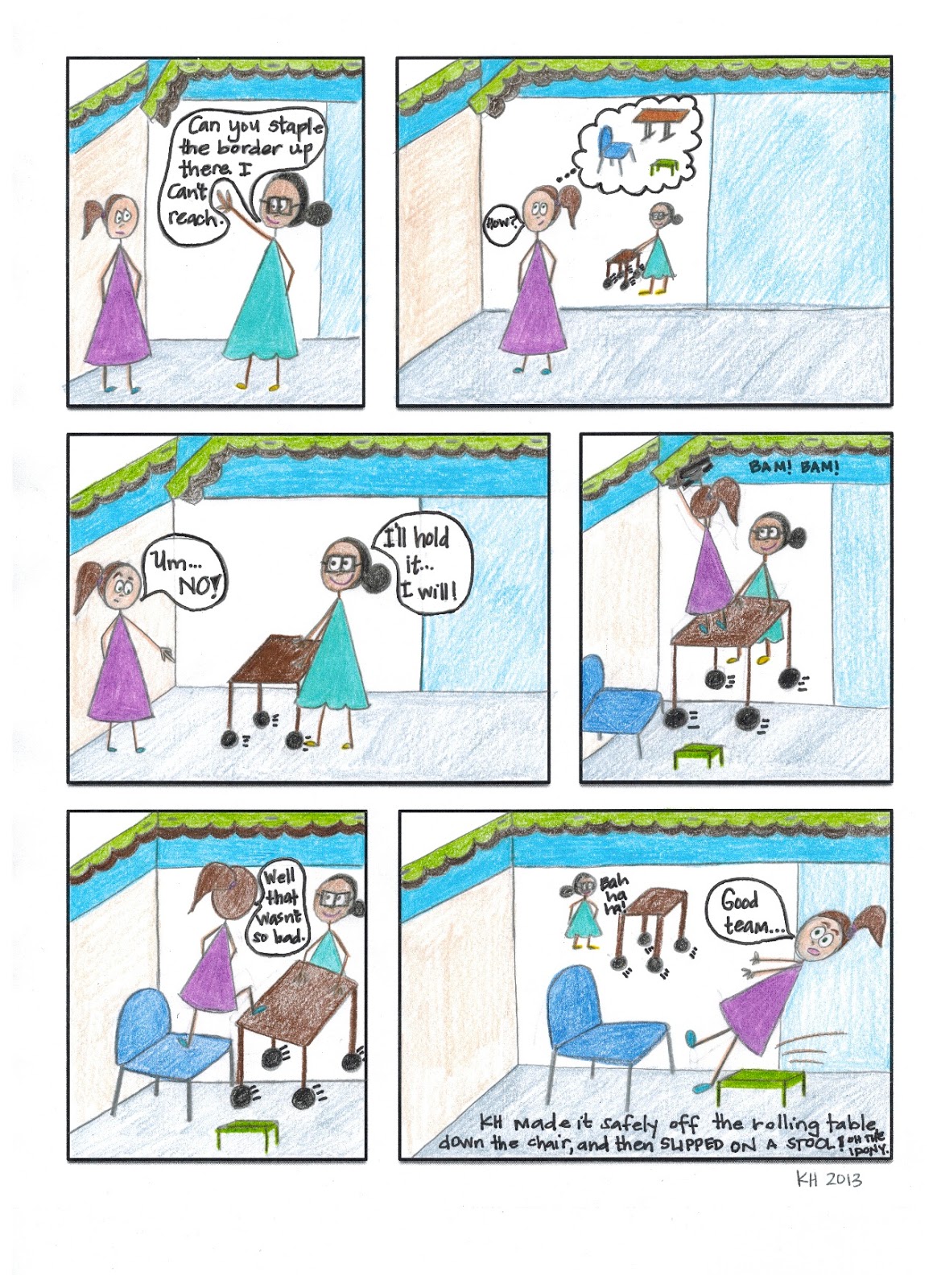
Anyway, while we were working on hanging some border, we had a funny moment and we thought we'd share in true Two On a Limb comic style, so enjoy!

Kristin was okay and we had a good, long laugh over the irony.

So best of luck to those who are just gearing up for the new school year and keep on keeping on to our dear friends who are already back in the trenches. Happy new school year!

From the limb,

Sunday, August 25, 2013

Special Columbia Edition of How To: Create Teaching Points

There are few things we love in life:  cupcakes, antiquing, Chris Hemsworth as Thor, and Pinterest to name a few.  But one classroom fav. is a strong teaching point.  A teaching point is a few sentences that define what we want our students to learn from any particular lesson.  While writing her teaching points, Kristin prefers to start with good readers do X, good writers do Y, or good mathematicians do Z.  After the Columbia experience, Kristie now prefers to add thinking prompts to her teaching points.  Today's how to is all about our beloved teaching points.  We will address what they are and how to create them to guide your instruction.

Ok, people, class is in session.  Welcome to Teaching Point 101.
At the foundation of all mini lessons is the mighty and powerful....TEACHING POINT.  Teaching points anchor your lessons and give them purpose.  They tell your students what they will be learning, how to apply the new learning, and why it is important that they do.  They help your instruction stay focused and explicit.  Without a crystal clear teaching point, your lesson will just unravel in the wind.

Let's talk about the anatomy of a good teaching point.  One of our small group leaders at the Teacher's College of Columbia Reading and Writing Project (TCCRWP), Alison Porcelli, broke teaching points down into three basic parts:
  1. Skill - what you are teaching
  2. Strategy - how they will do it
  3. Value - why it is important
Here is an example of a teaching point used in one of Kristie's small group sessions with Alison. It focuses on teaching the elaboration technique of twin sentences when writing informational texts:  

Writers can write twin sentences by stating a fact and then asking themselves, "What more could I say?" and writing that down in the next sentence.  We do this so that the reader understands what we are trying to teach.  

Can you identify the three parts (skill, strategy, value) of that teaching point?  

Here is the answer key:
The skill is twin sentences.  
The strategy is stating a fact and then using self-questioning to add more information about the fact. 
The value is using this skill to elaborate in order to help the reader understand what it is you are trying to teach.  

Now that we've covered the what and why of teaching points, let's delve deeper into the how.  Wouldn't it be nice is there was a book called Teaching Points that listed every conceivable teaching point by curricular area and you could use it like a choose your own adventure guide?!?!?!  
Awww memories....
The bad news - consider your dreams dashed because one such magical tome does not exist.  The good news - you have everything you need to make your own teaching points!  Yay!  No?  Still smarting about the teaching point book bit?  Our bad....sorry about that. 

At Teacher Camp (aka TCCRWP), our camp counselors leaders shared tips for choosing teaching points.  Although their suggestions were centered around writing, the basic principles apply across curricular areas and can be used as a guide when developing your own teaching points in any subject area.  Without further ado, here are some ideas for sources you could use to create the skill aspect of your teaching point:
  • Consider your target audience's zone of proximal development.  Ask yourself "What are my students using, but confusing?"
  • Base it on student intention.  You might ask students what they want to do next when conferring with them.
  • Consider their level of independence on a skill or strategy and use learning progressions to determine next steps.
  • Examine student work for patterns.  You could look through the lens of extension or remediation. 
Now that we have reviewed possible sources for the skills aspect, we are ready to write the first part of a teaching point.  Here is the beginning portion of a teaching point that could be used in a mini lesson for beginning writers who are telling a story through pictures:

Writers can use illustrations to tell their stories by....

Next up is the strategy.  How are they going to perform the skill?  What thinking prompts could you give your students to help them use the skill independently?  Unfortunately, there aren't any short-cuts here.  This just takes some thinking on your part and use of strategies and routines from your own professional skill bank.  As we mentioned above, Kristie likes to add thinking prompts to her teaching points.  The addition of thinking prompts to a teaching point gives your students a question to ask themselves in order to remind them how to apply the skill.  A simple thinking prompt that you might use is to ask yourself what do your students need to do in order to apply the skill.  Let's go back to the example skill of conveying information through illustrations.  In order to do that, students need to read their pictures and think about what parts of the story the reader is seeing.  If that were to be added to our teaching point, we'd have:

Writers can use illustrations to tell their stories by reading their pictures, then asking themselves "What more could I add to help the reader see more of my story?" and then adding those details to their illustrations.  We do this.....

The most important part of the teaching point, the part that most often gets left out, is the why.  If we want students to apply the skills and strategies we teach, it is important to give them a reason why they should.  When thinking about the value of a particular skill you want to teach, the best way to determine the why is to ask yourself what value does this add to my students as independent readers, writers, thinkers, etc.  You could also think of it through a different perspective by asking yourself if they didn't do the particular skill in question, what would happen?  A "so what" question if you will.  If we were to consider the example skill of conveying information through illustrations, what would the value be in teaching that skill?  Why should students care about adding to their illustrations?  They might add to their illustrations to make their story clearer or to develop the characters in their story or to give more information than is conveyed by their text.  No one particular reason is more right than the other; it really just depends on the purpose of the lesson and what you are trying to get your students to do more of independently.  If we were to add the "so what" to complete our teaching point, it would read:

Writers can use illustrations to tell their stories by reading their pictures, then asking themselves "What more could I add to help the reader see more of my story?" and then adding those details to their illustrations.  We do this so that the reader can understand the whole story.  

This concludes Teaching Point 101.  The next time you sit down to plan a mini lesson or a small group lesson, think about what teaching point you will create to anchor your instruction.  

From the limb,