Saturday, April 5, 2014

It Was a Crate Idea!

Are we the only people who get inspiration from weird, random places? That's the funny thing about inspiration, we suppose ... you never know when it's going to hit you. Well ... we recently got some inspiration from a weird source: freezer meals. Do you know about freezer meals? Some amazing people make enough meals for one month and then they freeze them. Talk about organized!!! See ...

The philosophy behind freezer meals or make-ahead meals is that it's more time efficient to do things once even if it's a lot of things at once. For example, if you're chopping vegetables for dinner, you might as well go ahead and chop vegetables for all your dinners that week. Big effort BUT saving time by doing the repetitive activity only once. You see? Let us tell you how this inspired us.

We have a weird cycle when it comes to preparing for the week. We are pretty much have everything prepared for the week in our core instructional areas by Monday morning, give or take a few things. That's good, right? Things prepared for the week, plenty of time to get started on the next week. WRONG! Somehow every week our time gets eeked away and we end up like this on Friday afternoon:


It's not a good look! It leaves us stressed and frazzled through a final early morning push on Monday and then - phew - we're ready for the week. We have repeated this lovely cycle week in and week out so far this year - hating it but not knowing how to change it. Enter our freezer meal inspired idea. We give you ...
OUR CRATE!!!


We pride ourselves in our differentiated reading program and we strive to provide our students with targeted instruction to meet their specific reading needs during our Reader's Workshop block. One component of our program is our phonics strategy groups. We run our phonics groups in six week cycles and the children move flexibly in and out of the groups based on their needs and their growth. For the phonics cycle we're in currently, we have four different strategy groups running, each with their own 6 weeks worth of lesson plans. B.C. (before crate) we were pulling each lesson and all of its supporting materials every week and putting it into our lesson plan totes.


It was the same thing again and again ... a lot of work every week to pull and prep, pull and prep. Then the crate was born:


The crate holds all of the instructional material for all 6 weeks for each phonics group. Each phonics group has a different color hanging folder to differentiate it from the other groups. Each hanging folder is labeled by week and all of the instructional materials for the week are dumped into the folder.


There are also a few hanging folders with support materials, such as our Dictation sheets and Draw and Label sheets that we use weekly. Finally, each phonics group has a checklist (we LOVE checklists) so that we can keep track of our prepping and reference what hasn't been completed yet.


You can download this document here.
KM worked on the crate all week, which seems like a lot of time, but then it was ALL prepped ... for SIX WEEKS ... ALL prepped ... can we get an "oh yeah!" Now she just pulls everything out of our lesson plan totes and dumps it back into the "Week X" folder it came from, and then puts all of the materials for the next week in the totes. SO ... MUCH ... EASIER ... and less stressful. KM is now officially more obsessed with the crate than our pencil sharpener.

One thing that we've learned about teaching 40 plus kids and striving to provide them with the most differentiated, targeted instruction that we possibly can, is that we have to stay organized. It's the only thing that keeps our train on it's tracks and keeps us sane. It's always a huge victory when we think of something that will help make our jobs go just a little smoother. So we're passing this along to you to see if you think it's a "crate" idea, too.

From the limb,

Tuesday, January 21, 2014

The Scheduling Squeeze #1: There Is No Such Thing as a Panacea

So CONFESSION TIME ... we wrote the following blog entry last summer. Yep, last summer, as in 5 months ago aaaaaaand we're just now posting it because despite sitting on it all that time, we do think it's pretty awesome. We could have edited it to pretend that we wrote it right now, but let's face it

So, yeah ... enjoy!!

Scheduling the school day sucks (please excuse the salty language but we are fired up). It is the bane of our existence. It is the source of constant headaches. It creates tension between us as we battle to fit everything that is important into each day. All last year we struggled with our schedule.

Back, Time Dragon, back!!!
Where could we find more time? Where could we squeeze this in? How could we accommodate this? KH became a scheduling contortionist, twisting and turning, at times almost magically pulling extra minutes out of thin air, in order to accommodate the diverse needs of our students. And while we were able to accomplish a lot and we are proud of the program we built last year, there were also stresses that came directly from the schedule. We were scheduled so tightly that any little thing could knock us off our timetable. There was this constant sense of stressed time ... next, next, next ... we have to fit in more, more, more!

While we have always experienced this sense of schedule crunch, of not being able to fit in everything we think is important into our day, this feeling seemed particularly prevelant last year. We made a commitment to ourselves this year to try to streamline and integrate, particularly our reading and writing program, in order to maximize our time with our students. And we thought we had a genius plan - a Reader's and Writer's Workshop combined. We were set and we were excited ... it was going to be epic. And then we went to New York.

Specifically we went to Columbia's Teacher College Reading and Writing Project (you can read about that experience here) and had the amazing opportunity to learn all about how we could improve our writing instruction and program. This was both inspiring and frustrating because no matter how we rearranged the schedule, no matter how we spliced up our time - it was never enough. GARRRRR!!!

It is so unbelieveably frustrating to know what you need to do in order to provide an exceptional instructional program, to have the pedagogical know-how, the resources, and the professional confidence in your abilities, and to be halted from realizing it only by the limitations of time. And after KH had made the tenth revision of the schedule over the first two days of the conference, she was banging her head against the wall (Well, actually it was one of those teenie tiny college desks - what's up with that, anyway - college kids don't need room to write???) Why was this so hard, so much harder than scheduling when we were teaching on our own? Then she had an epiphany! Small group! The problem was small group instruction.

Now please, PLEASE, PLEASE do not misunderstand us. We love small group instruction. It's our middle name. It's the heart of our educational philosophy. It's the instructional practice we hang our hats on. It's the air we breathe. It's ... we could go on ... really we could. BUT it's also a gosh-darned scheduling nightmare!

Oh, Ryan. Stop! We're blushing!!

This is why. Small group instruction takes time. More time, we realized, than we initially anticipated when we started this journey together. This may seem really obvious but boy was this a revelation to us. You see, once we were able to get our kids working independently last year and we were able to engage in meaningful, focused, rigorous, differentiated small group instruction, we were hooked. We became gluttonous, voracious, insatiable. We wanted more, more, more! We spliced our time up into 15 minute chunks an we rotated, rotated, rotated. We were addicts and the high was amazing, but with anything there is always a cost. The cost for us is time. There is realistically not enough time in the day for us to teach reading, writing, and math through small group instruction without making sacrifices.

Let us repeat that ...

There is realistically not enough time in the day for us to teach reading, writing, and math through small group instruction without making sacrifices.

Whew! Believe it or not, that was hard to say and an even harder reality to face. Last year we sacrificed whole group instuction, As we added small groups, whole group time was whittled away; we basically stole the time in order to have more time in small groups. In reflecting on the year, we realized we missed whole group time. We missed the moments when students at different places in their learning came together and taught each other. We missed the building of common instructional experiences. We missed the way kids were bolstered and validated when contributing to the knowledge of the class as a whole. We didn't want our classroom to be tiny pockets of kids working on their learning in isolation from each other. We knew there were key ideas and experiences that every student needed to have regardless of their instructional level. So we planned to add it back in, but there's also a cost in that plan: time for small group instruction. Annnnnnnd ... around we go again. Are you starting to see the headache, here?

This is a quandry that we have no solution for; we are in the woods on this. There is nothing we want to do that we feel is not essential; we have already trimmed the fat long ago. There's no fly away here, no wisdom we have to impart. We suppose we mainly wanted to vent our scheduling frustrations. But more importantly, we wanted to share our epiphany about small group. Small group is time consuming if done right - to group, to plan, to carry out. We want this reality to be acknowledged. Dedicating time to small group instruction is essential; we are small group's number one fan. But there has to be a balance. We're still working on finding ours but our epiphany was a helpful first step. Now back to fighting that dragon!

From the limb,

Saturday, November 16, 2013

How To: Make a Video Newsletter

Soooooo remember that post a little while back where we said that we tried something new and the verdict was still out? Well, guess what?!? Our newsletters are a huge hit!!!
The parents have been loving them, the kids have been loving them, and we have been loving not writing the newsletter tomes that we ended up with last year (Lawd, could we write a loooooooong newsletter!). We've had some unintended bonuses as well, like parents sharing the videos with grandparents. Cool, right?!? And the best part is that we can provide a little window into the classroom so parents can get a feel for what every day classroom life is like ... the good, the bad, and the ugly :) (We say the ugly because we do not censor our videos ... A kid is crying in the background - oh well! Someone is staring off into space instead of participating - whatcha gonna do! We include whatever we catch on film. And now you're probably thinking ... those are two bad booty chicks ... and you'd be right :)

You can read all about us being bad booty chicks here: Special Columbia Edition of How To: The First Rule of Chart Club Is ...
While we are by no means experts in making videos, we'd like to share with you our process for churning out a video newsletter every other week so you can see how we make ours with minimum muss and fuss because really we ain't got time for that! KH loves her some checklists so we're going to share our checklist for creating a video newsletter, our storyboard (oh yeah, get ready, this post is just going to be sprinkled with terms from the industry - the movie industry - cuz we're in the know like that), and some tips we've gathered along the way.

We apologize that we cannot show you any more of our videos to help convince you to take the plunge, but alas they now star our students and we do not want to post pictures of our students on our blog. You're just going to have to take our word on how awesome they are and see where our knowledge + your creativity can take you.

Our Process
Download here
Our Storyboard

Download here
Here is an example of our storyboard from our last newsletter:
Math Workshop Video Newsletter Storyboard page 1
Math Workshop Video Newsletter Storyboard page 2
And since we're Share-y McShare-ysons, we'd like to share with you some tips we have for making video newsletters.

Tips
1. Make a plan first
     Know exactly what you want to include and be sure to capture that. You may get other footage by happenstance, but the last thing you want is to try to cobble together a coherent video from a bunch of random footage. It'll make your job much harder and more time consuming and frustrating and ... you get the point.

2. Focus on the curriculum and the learning
     We use our video newsletters to highlight what we're learning and what our life in the classroom looks like. We do not use our video newsletters for quick reminders of things like field trips or homework. We include bulleted reminders on the email when we send out the link to our video newsletter.

3. Tell a story
     Think about your video as a story - the story of the learning or the story of the content in the classroom. Let your video walk people through your topic in a way that's organized and coherent, in a way that builds upon the previous section, as if you are giving someone a tour. For example, in our most recent video about Math Workshop, we used choronlogy to tell our story. We walked the parents through each element of Math Workshop in the order that the children experience them. We told the story of Math Workshop.

4. Use the kids
     Our first video starred us - BORING! - but we didn't want to continue that way for many reasons, vanity being one :) Now the kids make up 98% of the video and they LOVE being part of the video and sharing about the classroom.

5. Have someone else shoot your footage
     For example, our last video newsletter was focused on sharing our Math Workshop. We have a different parent volunteer that floats every day during Math Workshop so we can focus on teaching. Each day we just gave the parent volunteer our camera and a post-it with some things we wanted to include in our video. By the end of the week, we had most of the footage we needed for our video and it didn't take any of our instructional time.
Post-it given to parent of footage to shoot
6. Find a predictable format and stick to it
     We have made a format for our videos and that helps us when we make our plan and when we go to put it all together. This is our format:

Title Slide - It always says "Our Class News" and the date
Introduction - We always introduce the video together and we always say: "This is our class news for ... (date)." Then we preface with the focus of the video.
1-2 Topics - We always choose 1-2 topics to focus our newsletter on.
Topic Slides - We use topic slides to separate the topics.
Closure - We always end with the credits

     We always use the same fonts, the same title and topic slides, the same formats to layer text over video, the same transitions, etc. This may seem boring but it makes for so many fewer decisions when it comes time to put the video together and it lends a continunity that makes the videos seem like part of a series instead of stand alone pieces.

7. Layer video, text, and audio
     You can deliver a lot of information in a short amount of time by layering. We often layer text on top of our video footage to give more information about what is being shown. We also use audio clips over photos or video we've muted in order to explain what's going on. Finally, when we have students introduce parts of our video, we will write their lines on whiteboards so that the viewer can hear them and also read what they are saying in case the audio does not come through as loudly as desired.

8. Get yo' self some B-roll
     That's right. We KH knows video terms. Tape some stock footage of your students during different parts of the day. It can serve as a resource to pull from when you're putting together your videos. A parent volunteer is a great person to get some B-roll footage for you.

9. Keep it short and sweet
     Try to capture as much as possible in as little time as possible. Use a critical editing eye when reviewing your video. Does it drag anywhere? Is anything redundant? Do you get the idea of something without needing all of the footage? For example, we often use footage of our students singing, but sometimes the whole song can feel long so we'll cut it down to just 1 verse and the chorus. Be a critical editor; you don't have to use everything you shot.

10. Don't spend too much time on it
     Don't obsess about it being perfect; you'll make yourself crazy. Just get the footage you need and move on. Surprisingly, some of the best feedback we've received is how much the parents enjoy that we leave in the mistakes. We're being authentic about what really happens in our classroom and that resonates with them. So take it from two perfectionists - don't try to make it perfect.

11. So there isn't actually an 11th tip. We just didn't want to have an odd number of tips .... so ... yeah ... we're weird ... anyway ...

12. Celebrate yourself and your class
     You're awesome and the work you do everyday is amazing. Brag about it! 

Finally, a technical note: We use a flip camera mostly to get our footage. We also use stills from a digital camera and sometimes film directly on our MacBook Pro. We upload all of our footage into iMovie and use it to make our videos. We export them direclty from iMovie into Quick Time. We found after trying to share our first video newsletter that the files were too large to email out to parents so we upload them using Google Docs and then change the share settings so anyone with a link can view the document even if they do not have their own Google account. Then we email out the link to all of our parents.

We hope this was helpful and maybe even a little inspiring. We would be happy to do a more technical blog about how we use iMovie to make the movie if there's interest. If anyone tries a video newsletter themselves, we'd love to see it or hear how it went!

From the limb,

Thursday, November 14, 2013

Levity from the Limb #3

Anybody feeling a little like this lately?


The other day KH was doing a Core Phonics asessment on a kiddo. When they were done, she asked the kid to get her the next person to be tested. It went a little something like this:

Ms. H: Excellent job, Student X. Could you please get me Ryan Reynolds? Thanks.

As the child happily went off, KH started thinking to herself, "Wait, did I just ask her to get me Ryan Reynolds?" As in ...


Yep, Ryan Reynolds. There's really nothing more to say after that except ...

WHY DIDN'T SHE ACTUALLY BRING ME RYAN REYNOLDS?!?!?

That's the only thing that would have saved the day.


From the limb,

Wednesday, November 6, 2013

Lessons from the Limb #9: Our Collaboration

People often ask us how our partnership works and why it works so well.  They see us collaborating and automatically assume it works because we are friends or because “we live at work.”  While it doesn’t hurt to wake up and work with a good friend, someone you admire, someone who inspires you to do more, someone who pushes you...contrary to popular belief, friendship has nothing to do with it.  We work because who chose to enter into this partnership together.  More importantly, our partnership works because we work hard to make it work.  Recently KM attended a meeting and was presented with an interesting visual about collaborative teaching which we feel sums up the inner layers of our collaborative relationship:
Image taken from Daniel Wilson's presentation in the Learning Environments for Tomorrow presentation at Harvard (April 2012).
So let's breakdown each of these four layers and by the end of this collaboration expose, the secrets of our inner workings will be unveiled for the masses.  So with out further ado:

Layer 1.  Communication.  At the base of any healthy relationship is open and honest communication.  One of the reasons why we work is that we are open with each other.  We give each other feedback, we share ideas and pedagogical knowledge, we challenge each other and we give each other compliments.  While compliments are always nice, we also don’t hesitate to challenge each other to make sure the decisions we are making are aligning with our collective goals.  It’s never personal because at the end of the day we believe in each other and trust and respect each other.  To make sure we are always checking in with each other, we have a before school check in where we go over any big things for the day and an after school check in where we reflect on the day and make preparations for the next day.  When there is a breakdown in communication, there will likely be a breakdown in collaboration.    Sometimes that happens.  We are not perfect.  Sometimes we fight.  Nothing makes the collaboration crunchier as when there is a chink in a partnership’s communication.   

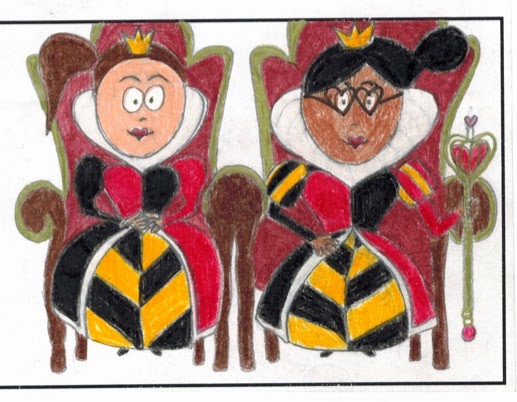
Layer 2.  Coordination.  While we were used to being the queens of our own classrooms, it was an adjustment to figure out how to rule our joint court.  There were some tough times where we tried to assert our dominance over each other.  For a collaboration to be successful, you can’t have two queens fighting for one throne.  We have found the most success in recognizing and utilizing each of our strengths and then using them to build each other up.  

"All ways here are our ways," said the Queens of Hearts.
Layer 3.  Cooperation.  Once our communication was solid, we had to make sure we were speaking the same language.  Before we started down this road of collaboration, we sat down and aligned our vision and philosophies.  You could have exceptional communication and be the best of friends, but if you don’t stand for the same things then…well….you’re heading for a hot mess.   Seriously.  It’s just like living with a friend.  Good friends don’t necessarily make good roommates.  Good friends don’t necessarily make good teaching partners.   Collaborative relationships require more than friendship and a shared love of rubrics.  You both have to be committed to pursuing the same goals and vision.  We work because each day we bring our A-game and it’s not about who thought of what or who gets credit for what, its about supporting each other to realize our vision for our students and their families.

Layer 4.  Collaboration.  When all the C’s combine, you have Captain Collaboration (cue Captain Planet theme song).  At the heart of all the four C’s lies collaboration.  When there is open and honest communication, you are both committed to the same goals, and you both work together to rule your domain, you have true collaboration.  Collaboration isn’t just about being in the same room together; it’s more about how you work together.  It is about you and your partner bringing ideas to the table to discuss and together turning them into something better than what you each could have created alone.  Our collaboration works because we are constantly reflecting, planning, brainstorming, nit-picking, revising, and reshaping our new normal together one day at a time.


So the FLY AWAY here is that just like any relationship, you get out of it what you put in.  You don’t have to be friends to have a successful collaborative partnership.  For goodness sakes you don’t have to “live at school.”  You just both have to want to be there and commit to each other and your shared goals.  If you end up becoming friends as a result of the experience, well we ain’t mad at ya. 


From the limb,
Sunday, October 13, 2013

Lessons from the Limb #8: "Fight Right", Y'all!!!

So ... we got in a fight ...


Alright, alright, we didn't get into a real fight, but we did have a disagreement - quarrel? dispute? clash? squabble? - about partnering up students, of all things, and we had to work it out. And while we did eventually come to an agreement in regards to student partnerships, the bigger take away we had was about communication and essentially how to "fight right". KH recently read a book called The Happiness Project by Gretchen Rubin ...

You can find it on Amazon here
... and one of the things that stuck with her the most was the idea that couples with healthy relationships "fight right" - they don't bring up past wrongs, they are able to laugh and joke amidst a spat, they try to really hear what the other person is saying, and they let things go once resolution is struck. While we are obviously not a couple, we think the principles of "fighting right" still apply because in many ways our relationship mirrors the components of a true marriage.

So with the idea of "fighting right" and the desire to improve our communication process, KH launched a conversation basically about how we felt our disagreement went and what we could do better in the future. This conversation, in true KH and KM reflective fashion, became a meta-analysis of our disgreement, almost like a post-game breakdown recapping each moment of the fight and where, if anywhere, commincation failures could be pinpointed with the hopes of avoiding them in the future. Now before you think we're crazy - though we admit you may have a point at times - we did this because we wanted to improve our communication, we wanted to make sure that when we were quarreling that we were still "fighting right".

We're sure that you are DYING to know the details of our squabble but, alas, we are going to disappoint you because this entry is not really about the fight itself, but what we learned from having the fight in the first place and then analyzing it together.

Realization #1: It is important to restate things to make sure that both of us are hearing the same thing.

     Revelation: Sometimes we are talking about two completely different things and we don't even realize it! Fail! Other times, we are saying the exact same thing - we actually agree! - and we don't even realize it. Double fail! Not a productive way to communicate.


     Resolution: We are going to work on following up key agreements in discussions by rephrasing. For example,


Realization #2: It is important to be crystal clear about what we've agreed upon.

     Revelation: Most often when we debate or disagree on things, they are complicated issues - regardless of what you may think after reading about our Alpha Wolf struggles for dominance. We have to sort them out and make a plan one layer at a time. What we have a tendancy to do is keep moving the conversation forward without being explicit about what we have agreed upon and what's still undecided. This either leaves us in the position of ending our conversation in a cloud of amibiguity ...


... or we keep rediscussing things we've already agreed upon. Either way, it's a waste of precious time and, as KM would say, "We don't have time for this nonsense!"

     Resolution: Well, our first plan was to hire a man named Icarus to act as our scribe and follow us around recording our agreements.


And while we're still holding out hope that someday we'll find him, in the mean time we're going to work on synthesizing exactly what we have agreed to BEFORE we move on, with each of us weighing in with a yes or no to confirm.

This all may seem ridiculous to the outsider, but one of the things we value most about our professional relationship and something we believe is essential to our success as a team is our ability to talk about and learn from our ups and downs. It would be so easy to let things fester or just leave things as they are, to accept the status quo, to not rock the boat and not push ourselves to dig deeper, but we are true believers in continuous improvement and that includes our professional relationship with each other, not just the pedagogy. After all this reflecting and discussing, analyzing and soul baring, our FLY AWAY is this: without communication and trust, collaborative teaching cannot reach its true potential for both the students and the teachers.

We'll leave you with this final reminder:

Stay classy, my friends!

From the limb,